Band
Level and secure, without riding up or painful pressure.
If the band feels wrong
If the cups fit but the band rides up, compare a firmer band. Cups that are too small can also make the band feel tight.
 the bra size calculator
Use two measurements to find a starting size and see what to try next.
Measure over a non-padded bra.
02 / YOUR STARTING POINT
Add both measurements to see a starting size.
A size to try, not a promise of fit. Different brands and cup shapes can fit differently.
Your measurements are close to a rounding boundary. Recheck them; a small difference can change the suggested label.
Enter valid measurements to see which size to try. You can read the fit checklist below at any time.
We cannot show every candidate in this sizing system. Use the UK reference above or choose a supported system; we will not leave out part of your result.
Use the label on the bra you are wearing for a fit check.
Our two-measurement and six-measurement methods use different measuring conditions and calculation rules. Take fresh measurements for each method; do not copy the readings across. More measurements do not establish that our six-measurement method is more accurate for everyone.
Read the methods and limits →Saves the two measurements in this browser.
Choose the sizing used by the brand, wherever you live. EU, FR and AU/NZ results are label references from Freya and Wacoal—not new measurements or a guarantee of the same fit.
Add both measurements to see a starting size.
How this calculator works ↗Only compare these if the cups feel comfortably filled and the band needs changing. Similar cup capacity does not mean identical fit.
Measure without a bra. Start fresh: measurements taken in a bra cannot be carried over from the quick estimate. Use a soft tape; do not compress breast tissue.
Start here, then check the fit. If several sizes are suggested, compare them in the same bra style. No calculation can guarantee fit.
Your leaning bust is smaller than another bust measurement. Recheck tape position and tension before relying on this result; this is a prompt to check, not a judgement about your body.
Enter valid measurements to see which size to try. You can read the fit checklist below at any time.
We cannot show every candidate in this sizing system. Use the UK reference above or choose a supported system; we will not leave out part of your result.
Use the label on the bra you are wearing for a fit check.
Our two-measurement and six-measurement methods use different measuring conditions and calculation rules. Take fresh measurements for each method; do not copy the readings across. More measurements do not establish that our six-measurement method is more accurate for everyone.
Read the methods and limits →Choose the sizing used by the brand, wherever you live. EU, FR and AU/NZ results are label references from Freya and Wacoal—not new measurements or a guarantee of the same fit.
Based on the ABTF community manual. Independently implemented, with our rounding and supported limits; results may differ from the ABTF online calculator. ABTF ↗
Optional local saving. The detailed record is separate from your quick measurements. Saving replaces the previous detailed record. Measurements are not uploaded or saved automatically.
ONE BRA · FIVE SIMPLE CHECKS
Trying a bra on? Check how it feels, one step at a time. No measurements needed.
This check stays on this page only. Finishing, exiting, refreshing or leaving clears it. Your saved measurements stay as they are.
YOUR OBSERVATIONS · NOT A FIT SCORE
Still uncomfortable? Trust how it feels. Stop wearing a painful bra and check the brand's fitting guidance or ask a fitter.
For wired bras, also check that the wires sit around the breast without digging or rubbing. For wire-free bras, skip the wire check. These are general observations for everyday bras; sports, nursing and post-surgery bras need guidance for that style.
Check both sides. A top-edge gap alone does not show that the whole cup is too large. Multiple issues or uncertain observations need another look before a size comparison.
Fit references: Bravissimo: fit checks · Bravissimo: hooks and fit questions · Wacoal: when to change cup or band
A NEXT STEP FOR THE BRA YOU HAVE
Gaps, spilling, a tight band, or a band that rides up? Start with what you notice and find one thing to check or compare next.
No tape measure or account needed. Answers stay on this page and are cleared when you leave or refresh. Nothing is saved.
YOUR NEXT STEP
A comparison to try, not a fit guarantee. You can stop whenever you feel uncomfortable.
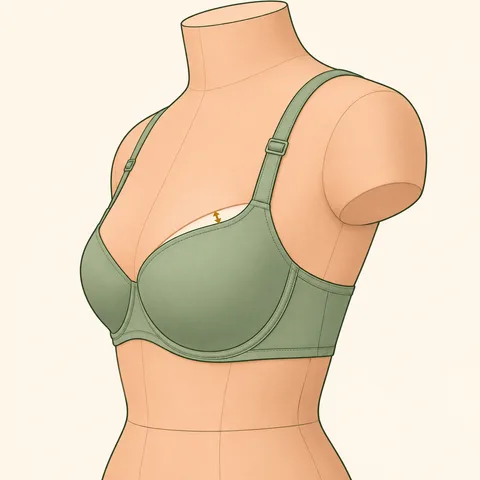
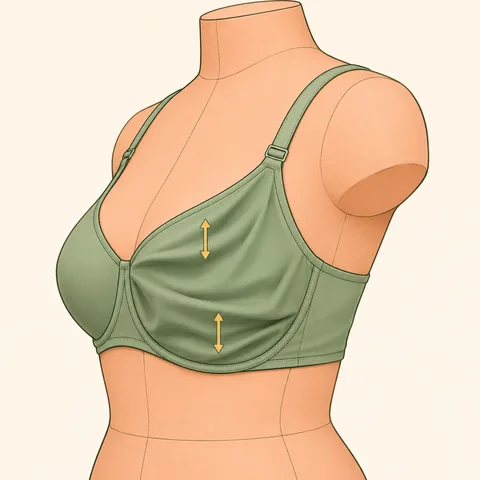
Illustrations emphasize the difference. Check how your own bra feels; folds alone do not determine fit.
A space at the upper edge and a cup that feels roomy throughout are different observations. Check both sides and note any spilling elsewhere before deciding what to compare.
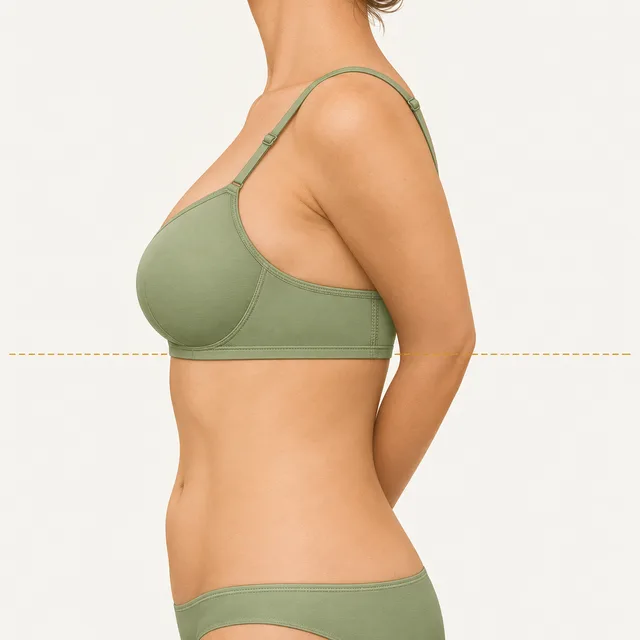
Settle the cups and adjust the straps without pulling hard. Try the loosest hook on a new bra with a hook closure. Look with your arms relaxed, then sit and move gently.
Compare the same style with a different cup size, a sister size when the cups fit but the band needs changing, or the same size in a different cup shape. Recheck comfort after each comparison.
Make sure the fuller side is comfortably contained before trying a more flexible cup edge for the side with a gap.
Compare with a less-worn bra if you have one, then check again. If the change persists, consider taking fresh measurements.
You can use the observations without knowing your label. S/M/L and brand-specific labels need that brand’s chart. Straps should stay in place without digging; wires, if present, should sit around the breast without pressing into it. If you cannot tell what is wrong, use the brand’s guidance or ask a fitter.
Need a fresh starting size? Read the measuring guide.
Fitting references: Bravissimo: fit checks · Bravissimo: hooks and fit questions · Wacoal: when to change cup or band
03 / Fit guide
One sign alone cannot tell you which size to change. Check the whole bra and how it feels.
Open the bra fit guide →Level and secure, without riding up or painful pressure.
If the cups fit but the band rides up, compare a firmer band. Cups that are too small can also make the band feel tight.
Breast tissue stays inside, with a smooth edge rather than spilling or empty folds.
Settle the tissue into the cups first. Cup size and shape can both cause problems; a gap alone does not mean you need a smaller cup.
Wires sit around breast tissue. Straps stay in place without digging in.
Wires should not rest on breast tissue. Many wired bras have a center bridge that lies against the chest; this is not a universal rule and does not apply the same way to wireless bras.
Fitting references: Bravissimo · ABTF
Optional reading. These examples describe cup features to compare, not a way to add or subtract cup sizes.
If a cup feels too shallow, compare a deeper construction rather than assuming a bigger cup letter will solve it.
An open or flexible upper edge may be worth comparing when the edge cuts in. Gaps can also reflect shape, not just size.
Check that the fuller side is comfortably contained. Stretch cup fabric may help accommodate the difference.
Quick and detailed measurements are saved separately on this device. Anyone using this browser may access saved measurements. Clearing browser data removes them.
MEASURE WITH CONFIDENCE
See where to place the tape, how snug to hold it, and how the quick and six-measurement methods differ.
Follow the illustrated measuring guide →READ THE NUMBERS
Look up starting bands and US/UK cup letters. Learn why a cup letter only makes sense together with its band.
Explore the band and cup chart →COMPARE LABELS
Already know your size? Compare US, UK, EU, French and Australian/New Zealand labels using our brand references.
Convert a bra size →Yes. Open the optional detailed calculator for three underbust and three bust measurements, taken without a bra. It independently follows the ABTF community manual with documented product choices. More measurements do not guarantee a better fit; the detailed and quick methods use different measurement conditions.
Quick mode converts measurements to inches, rounds underbust to the nearest even band, rounds bust to a whole inch, then uses the difference for the cup step. Halfway values round up. The result is a starting size, not a fitting guarantee.
Yes. Choose centimeters and enter your measurements directly. We use exactly 2.54 cm per inch. Switching units keeps the same underlying measurements.
Many smaller cup labels match, but the sequences diverge after DD. For example, this calculator maps UK E to US DDD, and UK F to US G. Check the specific brand’s chart.
A sister size changes the band one step and the cup in the opposite direction to keep roughly similar capacity. For example, 34C has nearby sister sizes 32D and 36B. They can feel different.
It can give you a useful starting point. Measurement technique, breast shape, bra construction and personal comfort affect fit. We do not claim a universal accuracy percentage or recommend a specific product.
Not necessarily. Size, cup shape and how the bra is positioned can all contribute. Check the band and the whole cup before deciding to size down.
This quick method supports underbust 26–50 inches and cup differences of 0–12 inches after rounding. Those are tool limits, not limits on normal bodies. Recheck the units and measurements, or use another fitting method.
Calculations run on your device. Measurements are saved only when you choose Save, and stay in this browser. They are not placed in URLs or sent to our server. There are no accounts or photo uploads.
Method reviewed: September 29, 2026 · Method & sources